
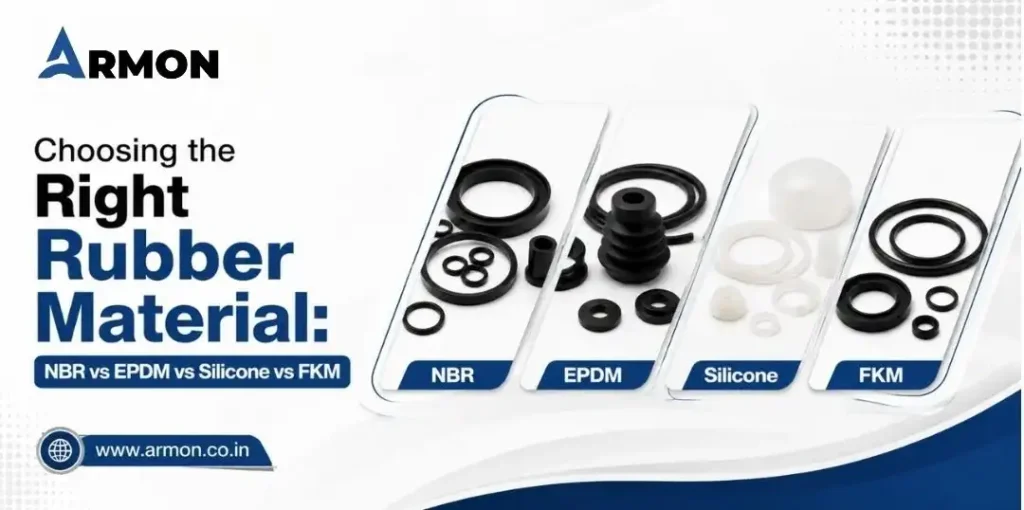
Picking the wrong rubber compound is one of the most expensive mistakes an engineer or procurement team can make. A seal that looks identical to the right one on a drawing can fail in weeks if the elastomer doesn’t match the application — leading to leaks, downtime, warranty claims, and costly re-tooling.
At Armon, material selection is where every project starts. Before a single mould is cut, our team works with customers to match the compound to the operating environment — temperature, media contact, pressure, and expected service life. This guide breaks down the four most commonly specified rubber materials — NBR, EPDM, Silicone, and FKM — so you can make a faster, more confident decision for your next component.
Why Material Selection Matters More Than Design
Two O-rings can have the exact same dimensions and hardness rating, yet perform completely differently depending on the compound. The wrong material choice typically shows up as:
- Swelling or softening when exposed to oils, fuels, or chemicals
- Hardening and cracking under heat or UV exposure
- Loss of elasticity in cold conditions, causing leaks
- Premature wear in dynamic sealing applications
Getting this right at the design stage avoids rework later — which is why compound selection is treated as an engineering decision, not an afterthought.
NBR (Nitrile Rubber) — The Workhorse for Oil & Fuel
Best for: Automotive fuel systems, hydraulic seals, pumps, O-rings exposed to oils and greases
NBR is the most widely used rubber in industrial and automotive sealing because of its excellent resistance to petroleum-based oils, fuels, and hydraulic fluids. It offers good abrasion resistance and holds up well under moderate pressure and mechanical stress.
Strengths
- Outstanding resistance to mineral oils, greases, and fuels
- Good tensile strength and abrasion resistance
- Cost-effective for high-volume production
Limitations
- Poor resistance to ozone, sunlight, and weathering
- Not suitable for high-temperature applications above ~100°C
- Degrades when exposed to strong acids or ketones
Typical operating range: −30°C to 100°C
EPDM — Built for Water, Weather & Outdoor Exposure
Best for: Irrigation systems, washers, gaskets, outdoor and weather-exposed components
EPDM is the go-to choice whenever a component is exposed to water, steam, or the outdoors. Its molecular structure gives it exceptional resistance to ozone, UV radiation, and weathering — making it a natural fit for irrigation and sprinkler components, where parts sit outdoors and in direct water contact for years.
Strengths
- Excellent resistance to water, steam, and weathering
- Strong performance in outdoor and UV-exposed environments
- Good resistance to alkalis, acids, and polar fluids
Limitations
- Poor resistance to mineral oils, fuels, and hydrocarbons
- Not suitable for applications with any petroleum-based media contact
Typical operating range: −40°C to 150°C
Silicone — When Temperature Extremes Matter Most
Best for: Medical and appliance seals, high/low temperature gaskets, food-contact components
Silicone stands apart for its ability to remain flexible across an extremely wide temperature range, from deep cold to high heat, without significant loss of elasticity. It’s also biologically inert, which makes it a preferred material for medical, food-grade, and household appliance applications.
Strengths
- Performs reliably from very low to very high temperatures
- Excellent flexibility retention across temperature swings
- Odourless, tasteless, and suitable for food/medical contact grades
Limitations
- Lower tensile strength and tear resistance than NBR or FKM
- Poor resistance to fuels, oils, and abrasive wear
- Not ideal for dynamic, high-friction sealing applications
Typical operating range: −60°C to 200°C+ (grade dependent)
FKM (Viton) — Premium Performance for Harsh Environments
Best for: Aerospace, high-temperature automotive, chemical processing, demanding industrial seals
FKM is a premium fluoroelastomer specified when a component must survive aggressive chemicals, high temperatures, and harsh media simultaneously. It’s more expensive than the other three materials here, but for critical applications, that cost is offset by a significantly longer service life and lower failure risk.
Strengths
- Outstanding resistance to fuels, oils, and a wide range of chemicals
- Excellent high-temperature stability and low compression set
- Strong resistance to ozone, weathering, and oxidation
Limitations
- Higher material cost than NBR, EPDM, or Silicone
- Poor low-temperature flexibility compared to Silicone
- Not compatible with certain ketones, esters, and amines
Typical operating range: −20°C to 200°C+
Quick Comparison
|
Property |
NBR |
EPDM |
Silicone |
FKM |
|
Oil/Fuel resistance |
Excellent |
Poor |
Poor |
Excellent |
|
Water/Steam resistance |
Fair |
Excellent |
Good |
Good |
|
Weather/UV/Ozone resistance |
Poor |
Excellent |
Excellent |
Excellent |
|
Temperature range |
Moderate |
Wide |
Widest |
Wide (high end) |
|
Relative cost |
Low |
Low–Moderate |
Moderate |
High |
How to Choose: Ask These Questions First
- What media will the seal contact? Oil and fuel point toward NBR or FKM. Water and outdoor exposure point toward EPDM.
- What’s the temperature range in service? Extreme highs and lows favour Silicone; moderate ranges with oil contact favour NBR.
- Is the component exposed to sunlight or ozone? EPDM and FKM outperform NBR here.
- What’s the cost-to-lifespan tradeoff? FKM costs more upfront but often lowers total cost of ownership in harsh, critical applications.
- Are there regulatory or food/medical-grade requirements? Silicone is typically the default here.
Get Expert Help With Compound Selection
Material selection is rarely a simple lookup — most real-world applications involve some combination of chemical exposure, temperature cycling, and mechanical stress that needs to be weighed together. That’s where in-house compound expertise makes the difference between a part that lasts and one that gets returned.
At Armon, our engineering team works directly with customers across automotive, irrigation, pumps, and industrial machinery to recommend and mould the right compound for the application — from initial material selection through tooling and mass production.
Explore our rubber components or get in touch with our engineering team for help selecting the right material for your next project.